
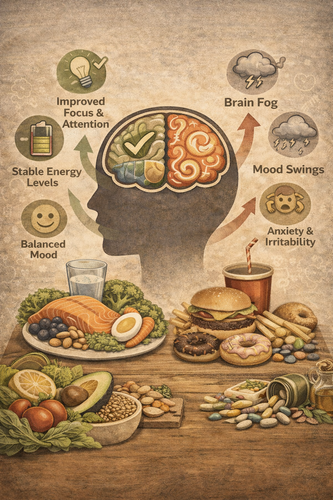
This month, we’re continuing our ADHD “Back to Basics” series—where we’ve already explored the powerful impact of sleep and exercise—and now we’re turning to how we eat, something we all do every day yet often overlook. If you’ve ever wondered why some days your brain feels clear and focused, while other days feel foggy and off (despite your best intentions), this one’s for you. We’re diving into how food affects the ADHD brain—not in a restrictive or overwhelming way, but with practical, realistic strategies you can actually use in real life.
Fueling the ADHD Brain Without Overwhelm
Let’s start with something most ADHDers know deep down—but don’t always connect in the moment: Some days your brain just works better than others.
You’re clearer. More focused. More emotionally steady. And other days? Everything feels harder—foggy, reactive, off.
We’ve already talked about two major foundations—sleep and exercise. But there’s another piece that quietly influences all of it:
Food.
Not in a “you should eat perfectly” kind of way. Not in a “cut out everything you love” kind of way. But in a very real, very practical sense: Food is fuel for your ADHD brain—and your brain is picky about the kind of fuel it runs on.
Why Food Matters More for the ADHD Brain
ADHD is, at its core, about how the brain regulates attention, energy, and emotions. Those systems rely heavily on neurotransmitters like dopamine and norepinephrine.
And here’s where the connection clicks: The building blocks for those neurotransmitters come directly from what you eat.
So while no food causes or cures ADHD, diet can absolutely influence how strongly symptoms show up .
This means the goal isn’t a perfect diet. It’s supporting a brain that already has more to manage—with a little more intention and a lot more compassion.
Start Here: Protein = Brain Stability

If there’s one place to begin, it’s protein.
Protein helps your brain produce the neurotransmitters that support focus, alertness, and emotional regulation. It also stabilizes blood sugar, which creates a steadier, more predictable experience throughout the day.
And this is where many ADHDers unintentionally struggle. Breakfast gets skipped, or it’s quick and carb-heavy, or it just doesn’t happen at all. Which means the brain starts the day already at a disadvantage.
A helpful reframe is to let go of the idea of a “perfect breakfast” and instead ask: What’s one small way I can add protein to what I’m already doing?
Maybe that’s eggs instead of just toast, yogurt with nuts instead of just fruit, or adding nut butter or a protein shake to your morning routine.
Because when your brain starts more stable, everything that follows gets a little easier.
The Quiet Game-Changer: Hydration
Once you start thinking about fueling your brain, there’s another factor that quietly shapes how you feel all day: water.
Even mild dehydration can affect focus, memory, clarity, and emotional regulation . And since ADHD already impacts these areas, the effects tend to feel stronger.
The challenge is that ADHD doesn’t just affect attention—it also affects awareness. It’s easy to miss thirst cues, ignore them, or simply hyperfocus past them.
So instead of telling yourself to “drink more water,” it’s often more helpful to make water easier to remember than to forget. Keeping it visible, pairing it with existing habits, or using a bottle you actually enjoy can make a surprising difference.
Like everything else here, it’s not about perfection—it’s about reducing one more barrier for your brain.
Understanding Energy: The Carb Rollercoaster

Now that your brain has some protein and hydration, the next piece is how it gets energy throughout the day.
ADHD brains are naturally drawn to quick sources of energy like sugar and refined carbs. They provide a fast boost in dopamine and can feel calming in the moment. But that boost is short-lived and often followed by a crash—brain fog, irritability, and that frustrating feeling of “I was fine and now I’m not.”
As your earlier post highlighted, refined carbohydrates can leave you feeling sluggish, while more balanced options provide steadier energy .
This isn’t about cutting out carbs. It’s about shifting how you use them. Instead of carbs on their own, try pairing them with protein or fat.
This simple change helps create more stable energy and fewer dramatic ups and downs. And by now, you may notice the pattern—we’re not overhauling everything. We’re creating more stability, one small shift at a time.
Supporting Brain Function: Healthy Fats
With more stable energy in place, the next layer is supporting how the brain functions overall.
The brain is made up of about 60% fat, and certain fats—especially Omega-3s—play an important role in mood, cognition, and emotional regulation .
This isn’t about eating less fat—it’s about including the right kinds. Foods like salmon, walnuts, flaxseeds, and chia seeds can all support brain health. And for those who don’t eat much fish, Omega-3 supplements can be a helpful option.
At this point, everything we’ve talked about is working together: protein builds the system, water supports it, carbs fuel it, and fats help it function smoothly.
And then there’s one more real-life factor that often changes the equation.
When Medication Changes the Equation

For many adults with ADHD, stimulant medication is part of the picture. And while it can be incredibly helpful, it often introduces a new challenge:
Appetite suppression
Which can quietly undo everything we just talked about.
When you’re not eating enough, blood sugar drops, energy becomes unstable, and emotional regulation gets harder—even if the medication itself is working.
So now the goal shifts slightly.
It’s not just what you eat—it’s making sure you eat at all.
This is where flexibility really matters. When appetite is low, full meals can feel overwhelming or even unappealing. Letting go of “what a meal should look like” can make this much easier.
Drinking your calories is often easier than eating them.
Protein shakes or smoothies can be a simple, effective way to fuel your brain without needing to sit down to a full meal.
It also helps to keep easy, low-effort options around. Even small amounts of food—like a protein bar, a handful of nuts, or yogurt—can make a meaningful difference and are often more tolerable when appetite is low.
At times, you may not feel hunger at all. In those moments, it becomes less about listening to your body and more about gently supporting it anyway. Setting reminders to eat—even something small—can go a long way.
And later in the day, appetite often returns. Planning for that window can help you get in more substantial nutrition, instead of relying on whatever is easiest in the moment.
At the end of the day, this is the key idea: Your brain still needs fuel—even when your body isn’t asking for it.
One More Important Piece: Timing Matters
There’s also a lesser-known factor that can impact how well medication works. Vitamin C can interfere with the absorption of stimulant medications.
This includes citrus fruits, juices, and vitamin C supplements. A simple guideline is to avoid vitamin C about 60–90 minutes before and after taking medication.
This isn’t about avoiding healthy foods—it’s just about timing them in a way that supports effectiveness.
Bringing It All Together
If this feels like a lot, let’s bring it back to something simple.
This isn’t about becoming a different kind of eater. It’s about understanding your brain a little better. Your brain responds to how you fuel it.
So instead of asking, “Am I doing this perfectly?” try asking, “Is this helping my brain feel more steady or less steady?”
Because every small shift—adding protein, drinking water, pairing foods, eating even when you’re not hungry—reduces friction and increases support.
So, what’s on your plate really does matter!