
Part 3: Cooking Without Burnout, Setting Up Your Kitchen, and Surviving the Days When It All Falls Apart
In Part 1, we explored how what you eat—and how you eat—impacts your ADHD symptoms. In Part 2, we talked about why feeding yourself can feel so difficult when you have ADHD (hint: it’s not a willpower problem, it’s an executive function problem), and we introduced the E.A.S.Y. framework: Easy, Available, Simple, Yours.
Now let’s get practical.
 This is the part where we actually set you up to win.
Cooking Without Burnout
Here’s something I tell almost every client: cooking burnout isn’t about cooking too much. It’s about cooking with too many decisions.
You know the scene. You open the fridge with big plans. Three minutes later you’re standing in the glow of the fridge light, holding a jar of capers you bought for a recipe you made exactly once in 2023, no closer to dinner than when you started.

That’s not a lack of motivation. That’s a brain drowning in tiny choices: What protein? What seasoning? What side? Do I even have everything? Wait… what was I doing? By the time dinner is theoretically ready, you’ve already spent your follow-through budget on decision-making and have none left over for, you know, cooking. So instead of asking, “What should I cook?” try this:
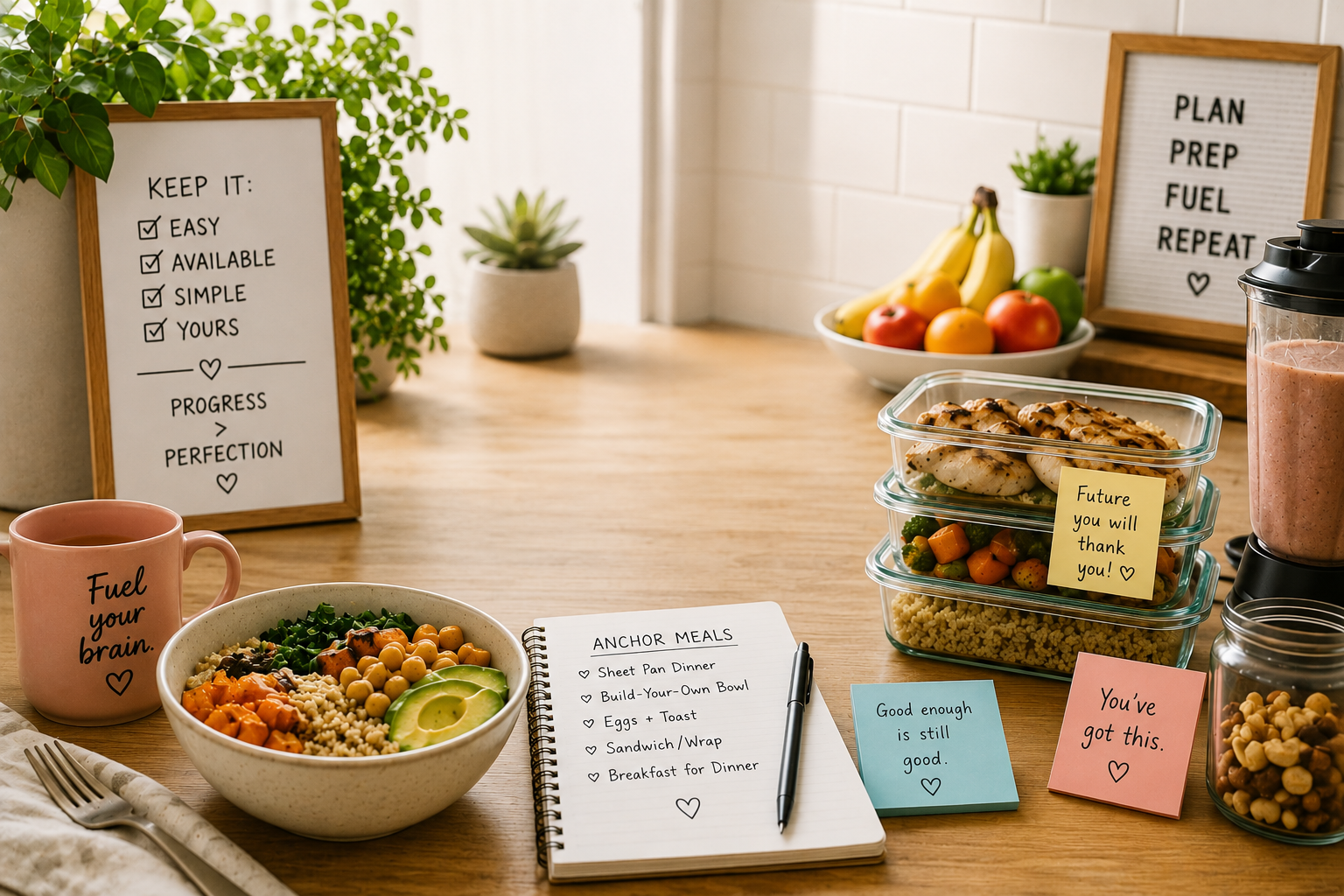
1. Pick 3 to 5 “Anchor Meals” 
These are meals you could make half-asleep. You already know the steps, you know where the ingredients are, and you can probably picture the exact pan you’d use without thinking.
When life gets chaotic, anchor meals become your autopilot. They remove decisions and give you something reliable to fall back on when your brain is already working overtime.

2. Rotate, Don’t Reinvent
You are allowed to eat the same five dinners on repeat.
Toddlers have known this for years. There is wisdom there.
Your goal is nourishment, not auditioning for a cooking show. The ADHD brain often craves novelty, but when it comes to feeding yourself consistently, repetition can be a superpower.
3. Batch the Boring Parts, Not the Whole Meal
Cook a tray of chicken or a pot of rice once, then use it three different ways throughout the week.

This isn’t meal prepping for the gram with matching glass containers. It’s meal prepping so future-you isn’t standing in the fridge light again on Wednesday wondering how cereal became a dinner option.
4. Lower the Activation Energy 
ADHD brains don’t just struggle with doing things. They often struggle with starting things. The fewer steps between you and food, the more likely food actually happens.
Frozen vegetables count.
Pre-cut fruit counts.
Rotisserie chicken counts.
Bagged salads count.
Anything that makes feeding yourself easier counts. You do not get extra points for making life harder.
5. Cook with Backup Noise

A podcast. A favorite playlist. A true crime episode. A friend on speakerphone narrating their day. Many ADHD brains need a second source of stimulation to tolerate repetitive tasks. That’s not a character flaw. That’s just the wiring.
The goal isn’t to become a person who loves cooking. The goal is to become a person who reliably eats, even if “cooking” is technically just reheating something with a vegetable nearby.
Setting Up an ADHD-Friendly Kitchen
Your kitchen should be doing some of the executive functioning for you, not adding to your load. A few small changes can make a surprisingly big difference.
- Make the Healthy Choice the Visible Choice
Put fruit in a bowl on the counter, not in the crisper drawer where it will quietly become a science experiment. Out of sight really is out of mind—and eventually out of date.
- Pre-Portion or Pre-Wash What You Can
Cut veggies. Washed greens. Individually portioned snacks. You’re not being fancy or lazy. You’re removing steps between yourself and a good decision. Remember: every extra step is another opportunity for the ADHD brain to wander off and start doing something else.
- Keep an “Emergency Shelf”


Stock a few shelf-stable, no-prep options for the days when cooking simply isn’t happening.
Some ideas:
- Nut butter
- Crackers
- Protein bars
- Tuna pouches
- Nuts
- Roasted chickpeas
- Canned beans
Think of it as a vending machine that only you have the code to.
- Label Things, Even if It Feels Silly
A sticky note that says EAT ME FIRST on the produce about to turn is not embarrassing. It’s a strategy. And it’s a lot cheaper than the guilty walk to the compost bin every Sunday.
- Keep Your Most-Used Tools Out

If your blender lives in a cabinet behind the waffle iron, the slow cooker, and a mystery appliance you got as a wedding gift, it has effectively left your life. If it lives on the counter, you might actually use it.
- Keep Food Where You’ll See It
One of the biggest ADHD food challenges is forgetting food exists until you’re suddenly starving. Keep healthy grab-and-go options at eye level whenever possible. Your future self shouldn’t have to go on a scavenger hunt to find lunch.
A kitchen that works with your brain will always beat a kitchen that just looks organized on the days someone else walks in.
Easy Meals You Can Rotate
Think variety within repetition, not a new recipe every night. A few starting points:
- Eggs, any way, plus toast and fruit—the breakfast that has saved more dinners than it has any right to
- Sheet pan dinner: protein and veggies, one pan, one timer, minimal cleanup
- Build-your-own bowl: rice or quinoa, a protein, whatever vegetables are hanging on in the fridge, and a sauce that makes it feel intentional
- Sandwich or wrap plus something on the side, because a sandwich is a completely legitimate dinner and anyone who tells you otherwise has clearly never had an ADHD Tuesday
- “Breakfast for dinner” nights, because eggs and toast at 7 p.m. count just as much as they do at 7 a.m.
None of these require a recipe. That’s the point. The fewer decisions standing between you and food, the more likely the food actually happens.
What To Do When Everything Falls Apart (Because It Will)
This is the part most food advice skips. It’s also the part that matters most. There will be days when the sink has a dish situation that’s developing its own ecosystem, nothing is planned, and the idea of cooking anything feels like climbing a mountain in flip-flops. That is not a failure of your system. That is just a Tuesday with ADHD.  When that happens:
1. Drop the Bar All the Way Down 
- A protein bar or shake.
- A handful of nuts.
- A bowl of cereal and milk eaten standing over the sink at 9 p.m.
- A can of tuna
- Peanut butter & jelly. It’s not just for kids.

Not ideal? Maybe. Still food? Absolutely.
2. Don’t Wait Until You’re Starving
Many ADHD adults miss early hunger cues and don’t realize they’re hungry until they’re ravenous, irritable, and making questionable decisions involving delivery apps.
If you’re reading this and realizing you haven’t eaten in six hours, consider that your sign.
3. Skip the Guilt Spiral 
The story “I should be doing better” burns energy you need for the actual problem, which is simply getting food into your body.
Save the self-improvement seminar for tomorrow.
4. Use Your Emergency Shelf
This is exactly why you built it. Past-you saw this coming and left present-you a gift. 
5. Don’t Try to Fix the Whole System in the Moment
You do not need a new meal plan, a grocery overhaul, and a personality transplant at 8 p.m. when you’re running on fumes. You need dinner. The plan can wait until tomorrow.
6. Notice the Pattern, Gently, Later
If “everything falls apart” is happening every single day, that’s useful information. It’s data. Not evidence that you’re failing.
Simple meals done regularly beat ideal meals done rarely. That was true in Part 1, and it’s especially true on the nights when dinner is a granola bar eaten in the car.
Bringing It All Together
You don’t need a kitchen that looks like a magazine spread, a meal plan with seven new recipes, or the willpower to cook from scratch every night. You need a system that’s easy, available, simple, and yours—and a plan for the day it falls apart anyway. Because here’s the truth: the goal was never perfection. It was consistency, compassion, and a brain that’s a little better fueled than it was yesterday. 
That’s a plan that sticks. 
