
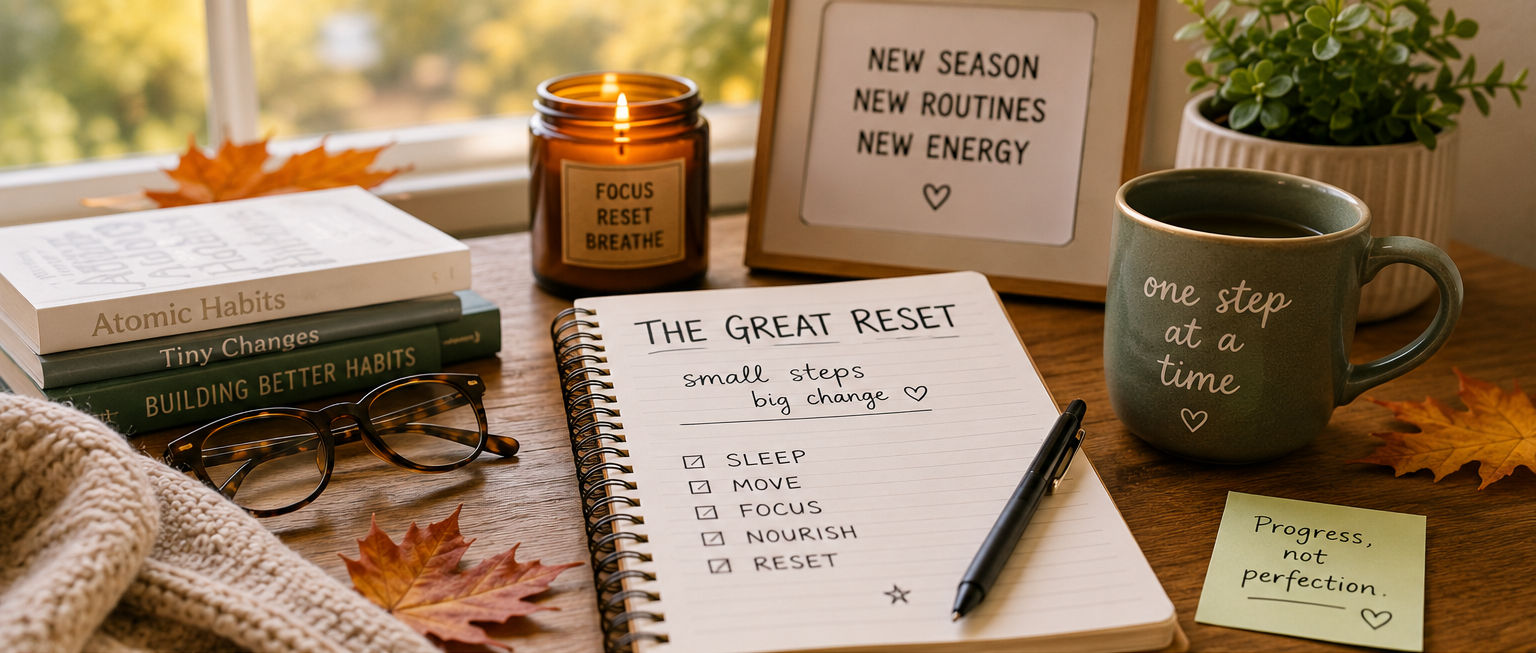
Hey there, ADHD friends. Let’s talk about what probably happened to your routines this summer.
The early bedtime? Gone. The morning walk? A distant memory. The tidy little systems you worked so hard to build last spring? Somewhere between the barbecues, the travel, the kids being home, and the sun still blazing at 8 p.m., they quietly dissolved. And now that fall is peeking around the corner, you’re looking at the wreckage and thinking some version of: “What is wrong with me? Why can’t I just keep things going?”
So let me say this first, clearly: nothing is wrong with you. Summer is practically engineered to dismantle routines for the ADHD brain. Our brains lean hard on external structure—the school schedule, the work rhythm, the daylight cues that tell us when to wind down. Take those away, add novelty and heat and a hundred delightful distractions, and of course the scaffolding comes down. That’s not a character flaw. That’s your brain doing exactly what ADHD brains do.
The good news? Routines aren’t something you either “have” or “lost.” They’re something you rebuild, on purpose, whenever you need to. And late August is the perfect moment to do it—gently, before the full weight of fall lands on you. Here’s how.
1. Pick ONE anchor. Not ten.
The single biggest mistake I see (and have made myself) is trying to reinstall the entire system at once—new sleep schedule, new workout, new meal prep, new planner—all starting Monday. For the ADHD brain, that’s not a fresh start; it’s an avalanche. And avalanches make us freeze.
Instead, choose one anchor habit—the one thing that, if you did it consistently, would make everything else a little easier. For most people it’s either a consistent wake-up time or a consistent bedtime. Start there. Just that. Let it get boring and automatic before you add the next thing.
2. Rebuild sleep first—it’s the domino that tips the rest.

If you only fix one thing this month, make it sleep. When our sleep is scattered, everything downstream—focus, mood, motivation, emotional regulation—gets harder. Summer almost always pushes bedtime later, so ease it back in 15-minute steps rather than trying to leap from 1 a.m. to 10:30 p.m. overnight.
Bookend your day: pick a rough “start” cue in the morning (open the blinds, step outside, same first song) and a “wind-down” cue at night (screens down, lights low, one calming thing). Your brain loves a predictable bookend far more than a rigid hour-by-hour plan.
3. Anchor new habits to things you already do.
Don’t rely on willpower or memory to reinstate a routine—rely on the habits already running on autopilot. This is habit stacking, and it’s one of the most ADHD-friendly tools there is. You attach the thing you want to do to something you already do without thinking.
- “After I pour my morning coffee, I write my three priorities for the day.”
- “After I brush my teeth at night, I set out tomorrow’s clothes.”
- “When I close my laptop, I do a five-minute tidy of my desk.”
The existing habit becomes the reminder, so your brain doesn’t have to hold onto it.
4. Make it visible—externalize everything.

Out of sight really is out of mind for us, so let your environment do the remembering. Put the planner where you’ll trip over it. Set the sneakers by the door. Use a whiteboard, sticky notes, or phone alarms with actual labels (“WIND DOWN ” beats a silent buzz). The goal is to build a home that nudges you, so you’re not depending on a brain that’s busy juggling forty other things.
5. Do a “soft launch” week.
You don’t have to snap back to 100% on the first day. Give yourself a soft launch—a practice week where you run the routine at half-speed and expect it to be clunky. Missing a day is part of the process, not proof it failed. A good routine isn’t one you never break; it’s one that’s easy to restart. So when you miss—and you will—just begin again at the very next opportunity. No catch-up, no guilt, no starting-over-on-Monday. Just the next small step.
Gentle reminder: You are not rebuilding because you failed at summer. You’re rebuilding because that’s what resilient, self-aware people do at the turn of a season. That reset instinct is a strength—lean into it.

This month, pick your one anchor and start there. That’s it. One small, doable step, repeated. Fall will come either way—let’s meet it a little more grounded than last year.
You’ve got this, and I’m cheering you on.
Feeling stuck on where to start, or tired of rebuilding alone every year? That’s exactly what coaching is for. Book a free consultation and let’s build a reset that actually sticks.